
Heating Tubes and Heating Rods
Heating tubes and heating rods are essentially the same type of product—resistance tubular electric heating elements. Their core function is to convert electrical energy into thermal energy; they are simply called different names in different industries and scenarios. They have a simple structure, low cost, and strong versatility, making them the most basic and widely used heating method in industrial temperature control and civil heating fields.
Heating tubes/rods work based on the heating effect of electric current (Joule effect). When current passes through the internal high-resistance resistance wire (nickel-chromium alloy wire or iron-chromium-aluminum alloy wire), the resistance wire generates heat due to its own resistance, converting electrical energy into thermal energy; the heat is conducted through an insulating thermal conductive medium (high-purity magnesium oxide powder MgO) to the metal sheath, and then heats the external medium (liquid, gas, or solid) through conduction, convection, or radiation.
Basic Structure
Metal sheath: stainless steel (SUS304/316L), titanium alloy, carbon steel, etc., providing mechanical support and corrosion protection
Heating element: spiral nickel-chromium wire (NiCr) or iron-chromium-aluminum wire (FeCrAl); some high-end models use PTC ceramics or nano heating elements
Insulating filling layer: high-purity magnesium oxide powder (MgO), with high temperature resistance (above 1000°C), high insulation, and high thermal conductivity, preventing short circuits and efficiently transferring heat
Sealed terminals: ceramic adhesive or silicone sealing, with moisture-proof, oxidation-proof, and leakage-proof functions
Type Structural Features Typical Power Application Scenarios
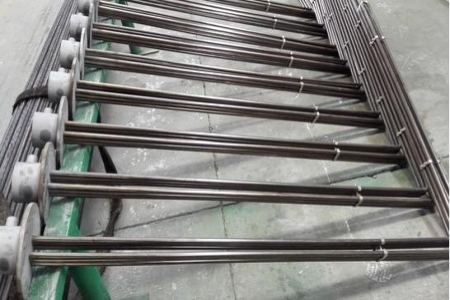
Single-head heating rod (single-end lead) Single-end wiring, tube diameter φ6~φ35mm 50W~several kW Mold heating, injection molding machines, hot presses
Double-head heating rod (U-shaped/straight tube) Leads at both ends, symmetrical structure 300W~5000W Water tanks, oil baths, pipeline heat tracing
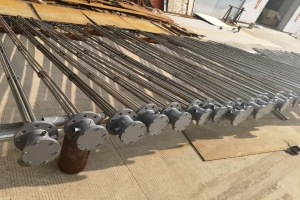
Flange-type/water tank electric heating tube Flange or threaded connection, multiple units can be combined 1.5kW~500kW Large water tanks, boilers, reactors
Finned heating rod Metal heat dissipation fins wound around the sheath 500W~several kW Ovens, air duct heating, air heating
Cast aluminum embedded heating rod Aluminum sheath integrally cast 500W~6000W Injection molding machine templates, die-casting molds, hot presses
By Material
Material Features Applicable Environment
SUS304 stainless steel Strong versatility, high cost-effectiveness Clean water, air, ordinary media
SUS316L stainless steel Better corrosion resistance than 304 Weakly corrosive liquids
Titanium Resistant to strong acids and alkalis, non-magnetic Electroplating baths, seawater desalination, PCB etching
Incoloy800/840 alloy High-temperature oxidation resistance, long service life High-temperature dry burning, high power density conditions
Quartz glass Fast heating, clean and pollution-free Laboratories, food equipment, optical constant temperature
Carbon fiber Good flexibility, extremely fast thermal response Medical equipment, 3D printing hot beds
By Heating Technology
Resistance wire type: the most traditional and mainstream, low cost, widest application
PTC ceramic type: positive temperature coefficient thermistor, with self-limiting temperature characteristics—after the temperature rises to the Curie point, resistance increases sharply and power automatically decreases; theoretically it will not overheat, with extremely high safety, but higher cost
Nano heating element type: uses nanomaterial technology, efficient heating, energy-saving and environmentally friendly
Tube diameter φ3mm~φ50mm (single-head rods can be as small as φ3mm)
Length 21mm~2500mm (customizable)
Voltage 5V~480V (commonly 24V/110V/220V/380V)
Power 50W~140kW
Surface power density Standard type 5~8W/cm²; high-power type 8~15W/cm²; ultra-high-power type 15~40W/cm²
Maximum operating temperature 700℃~850℃ (Incoloy 800 alloy can reach 760℃)
Insulation resistance Cold state ≥50MΩ
Withstand voltage 1500V~1800V
Diameter tolerance +0/-0.05mm
Length tolerance ±2mm
Power deviation +5%~-10%
Power density ≠ the higher the power, the better: for the same 1000W, when the length is 10cm, the surface load is as high as 8W/cm², which is highly prone to dry-burning oxidation; when the length is 30cm, the load is about 2.7W/cm², resulting in a longer service life. It should be reasonably matched according to the heating area and heat dissipation conditions
Material determines the applicable environment: ordinary stainless steel 304 is suitable for clean water; chlorine-containing solutions must use titanium or Incoloy800; corrosive acid-base environments are recommended to use Teflon-coated or ceramic-insulated models
Dimensional tolerances cannot be ignored: a diameter deviation of ±0.1mm has little effect on ordinary water tanks, but in precision mold heating holes (H7 tolerance), a deviation of 0.2mm may cause installation jamming or uneven heat dissipation
Lead wire type affects reliability: silicone wire is resistant to bending and suitable for frequent disassembly; Teflon wire combines temperature resistance (200℃+) and oil resistance; mica sheet leads are suitable for high-temperature fixed installation
Installation clearance: for single-head heating rods, a single-side clearance within 0.05mm is recommended, or the tube diameter should be about 0.1mm smaller than the mold hole diameter to ensure good heat conduction
Industrial Manufacturing
Injection molding machine mold heating, hot-pressing molds, heat-melt nuts
Die-casting molds, hot press base plates, laminating rollers/hot stamping roller heating
Chemical reactors, electroplating baths, acid-base solution heating
Fluid Heating
Water tank/oil bath heating, pipeline heat tracing and insulation
Boiler startup heating, steam tracing
Food and beverage heating (milk, juice, etc.)
Laboratory and Medical
Constant temperature baths, glass reactor heating
Constant temperature for small medical equipment
Civil Applications
Aquarium constant temperature heating rods (mechanical/electronic/PTC type)
Immersion beverage heating rods ("quick heaters")
Electric heating furnaces, electric water heaters
Non-standard Automation
PCB preheating tables, chip preheating, material softening tables
Ovens/aging test chambers, temperature control boxes
3D printing hot beds
Long-term dry burning is strictly prohibited: even if marked "short-term dry burning allowed," continuous no-load operation for more than 30 seconds may cause local overheating and carbonization of the insulation layer. Be sure to equip with a liquid level switch or temperature feedback closed-loop control
PTC type can be dry-burned but attention is needed: the surface temperature of a PTC heating rod automatically limits power at about 200℃ under no-load conditions and will not burn out, but long-term dry burning will still accelerate aging
Regularly test insulation resistance: after a period of use, the cold-state insulation resistance should be measured, and it should be replaced promptly if below the standard value
Avoid mechanical damage: avoid bending and collision during installation, especially for heating rods made of quartz glass and ceramic materials
Temperature control matching: use a thermocouple + temperature controller to achieve closed-loop temperature control, avoiding temperature control relying only on manual switches
Voltage matching: be sure to confirm that the power supply voltage matches the rated voltage of the heating rod; excessive voltage deviation will affect power output and service life
Comparison Item Heating Rod (Resistance Type) PTC Ceramic Heating Electromagnetic Induction Heating Pulse Heating
Cost Low Relatively high High High
Temperature control accuracy Requires external temperature controller Self-limiting temperature, average accuracy Requires external temperature controller Extremely high
Safety General (requires dry-burn protection) High (self-limiting temperature) Relatively high High
Applicable scenarios Continuous constant temperature, large-area heating Occasions with high safety requirements Metal container heating Instantaneous precision hot-press welding
Heating speed Medium Relatively slow Fast Extremely fast
Service life 8000~15000 hours 3~8 years Relatively long Relatively long
Summary: Heating rods/heating tubes are the most basic, most versatile, and most cost-effective heating solution, suitable for continuous constant temperature and large-area heating scenarios; when instantaneous precise temperature control is required, choose pulse heating; when extremely high safety is required, choose PTC ceramic heating.