
Heating Tubes and Heating Rods
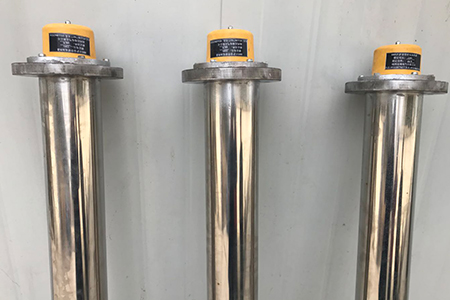
A heating tube (also called a heating rod or electric heating tube) is a general-purpose heating element that converts electrical energy into thermal energy, and is widely used in industrial, civil, aquarium, and many other fields. "Heating tube" and "heating rod" are essentially the same type of product, just with different names—the industrial field mostly calls them "heating tubes," while the aquarium and civil fields mostly call them "heating rods."
Heating tubes work based on the Joule effect of electric current: when current passes through the internal resistance wire, the resistance wire generates heat due to its own resistance, converting electrical energy into thermal energy; the heat is conducted through an insulating and thermally conductive medium (usually high-purity magnesium oxide powder) to the metal sheath, and then heats the external medium (liquid, gas, or solid) through conduction, convection, or radiation.
A typical heating tube consists of the following core components:
Metal sheath: made of stainless steel (SUS304/316L), copper, carbon steel, titanium alloy, etc., providing mechanical support, corrosion protection, and thermal conductivity
Heating element: the core component, usually a spiral nickel-chromium alloy wire (NiCr) or iron-chromium-aluminum alloy wire (FeCrAl); some high-end products use PTC ceramics or nano heating elements
Insulating filler layer: high-purity magnesium oxide powder (MgO) filled between the heating wire and the sheath, combining high temperature resistance (above 1000°C), high insulation, and high thermal conductivity, preventing short circuits and efficiently transferring heat
Sealed terminals: sealed with ceramic adhesive or silicone; the wiring terminals are threaded copper nuts or quick-connect tabs, providing moisture resistance, oxidation resistance, and leakage protection
By structural form
Table
Download as table
Export as image
Type Features Typical applications
Single-head heating rod Single-end wiring, high power density (5–40W/cm²), tube diameter φ3–φ35mm Mold heating, injection molding machines, packaging machinery
U-shaped/straight heating tube Double-end wiring, simple structure Water tank heating, boilers, reactors
Finned heating tube Metal heat dissipation fins wound on the surface, increasing heat dissipation area Ovens, drying equipment, air heating
Flange-type heating tube Flange connection, can withstand higher pressure Industrial liquid heating, steam boilers
Ceramic heating tube (MCH) Alumina ceramic substrate, energy-saving and environmentally friendly by 20%–30% Precision temperature control, medical equipment
By heating technology
Table
Download as table
Export as image
Technology Principle Advantages Disadvantages
Resistance wire type Nickel-chromium/iron-chromium-aluminum wire heats when powered Low cost, strong versatility, mature technology Requires external thermostat, risk of dry burning
PTC semiconductor type Positive temperature coefficient ceramic automatically maintains constant temperature Automatic power adjustment, water-electricity separation, no overheating Higher cost, relatively slower heating speed
Nano heating element type Nanomaterials for efficient heating Energy-saving and environmentally friendly, high thermal efficiency Higher cost
By temperature control method (mainly for aquarium heating rods)
First generation · Mechanical type (bimetallic strip): uses the difference in expansion coefficients of two metals to produce deformation as a switch, temperature control accuracy ±1–2°C, low price but has the safety hazard of "sticking and continuous heating"
Second generation · Electronic type (thermistor): detects temperature through a thermistor probe, microprocessor controls on/off, temperature control accuracy up to ±0.5°C, usually equipped with out-of-water power-off protection
Third generation · Smart type (WiFi/APP): supports mobile phone remote control and smart linkage, can set safe temperature ranges, most feature-rich
Download as table
Export as image
Parameter Typical range
Tube diameter φ3mm–φ50mm
Length 20mm–2500mm (customizable)
Voltage 5V–480V (commonly 24V/110V/220V/380V)
Power 10W–500kW
Surface power density Standard type 5–8W/cm², high-power type 8–25W/cm², up to 40W/cm²
Maximum operating temperature 700°C–850°C
Insulation resistance Cold state ≥50MΩ
Withstand voltage 1500V–1800V
Power deviation +5%–-10%
Diameter tolerance +0/-0.05mm
Industrial manufacturing: injection mold heating, hot-press molds, die-casting molds, heat staking/heat-melt nuts
Constant-temperature equipment: ovens, aging test chambers, temperature control chambers, preheating tables
Fluid heating: water tank heating, oil heating, chemical reactors, boiler startup
Roller heating: lamination rollers, bonding rollers, hot stamping rollers, packaging heat-sealing rollers
Aquarium field: fish tank constant temperature (resistive/PTC heating rods)
Civil appliances: electric water heaters, electric heaters, electric ovens, rice cookers
Medical equipment: sterilizers, disinfectors, constant-temperature incubators
Simple structure: extremely low failure rate, easy maintenance
Low cost: one of the most economical solutions in industrial heating
Strong versatility: customizable size, voltage, power, and shape, adaptable to various equipment
High thermal efficiency: electrical energy directly converts to thermal energy, with thermal conversion rate up to over 95%
Stable temperature: suitable for continuous constant-temperature heating scenarios
Clarify the heating medium: for liquids (water/oil/acid-base solutions), choose corrosion-resistant materials (stainless steel 316L/titanium tube); for air heating, choose finned type; for mold heating, choose single-head type
Determine voltage and power: select according to power supply conditions and heating area/temperature rise speed requirements
Size matching: for single-head heating rod installation clearance, it is recommended that one side be ≤0.05mm
Surface power density: choose according to heat dissipation conditions; dry-burning environments require low surface load, while liquid immersion allows high power density
Material selection: choose SUS304 for ordinary environments, SUS316L/titanium tube for corrosive environments, and Incoloy800/Incoloy tube for high-temperature environments
Temperature control method: pair with thermocouple + thermostat for closed-loop temperature control; for aquarium scenarios, electronic or smart type is recommended