
Heating Coil and Heating Plate
Heating coils and heating plates are two forms of electric heating elements that differ in shape but share the same principle, collectively forming the foundation of industrial and domestic heating. Simply put, heating coils are mainly used for wrapping around cylindrical objects (such as pipes and barrels) for heating, while heating plates are used for contact heating of flat or specially shaped objects. Common Core: Resistance Heating Principle
Whether it is a coil or a plate, the most mainstream working method is indirect resistance heating.
Heating Core: Both are embedded with electric heating alloy wires (such as nickel-chromium alloy, iron-chromium-aluminum alloy) as heating elements.
Insulation and Thermal Conductivity: The heating wire is evenly wound on insulating materials such as mica plates or ceramic substrates, or encapsulated in metal tubes filled with magnesium oxide powder, ensuring electrical safety while efficiently conducting heat.
Shell Protection: The outermost layer is wrapped with metal plates or tubes made of stainless steel, cast aluminum, cast iron, etc., providing mechanical protection, uniform heat dissipation, and enhanced structural strength.
Working Process: When powered on, current flows through the resistance wire generating Joule heat, which is transferred to the heated object through the insulation layer and metal shell via thermal conduction.
Differences in Form and Application
Although the principle is the same, different forms determine their distinct application scenarios.
Table
Download as Table
Export as Image
Feature Heating Ring Heating Plate
Core Form Ring, U-shape, spring shape, etc. Flat plate, grooved, special shapes, etc.
Heating Method Wrapping heating, tightly fitting around cylindrical outer walls Contact heating, fitting through bottom surface or grooves
Typical Applications Injection molding machine/extruder barrels, hot runner molds, pipe insulation, dishwashers, electric kettles Laboratory hot plates, industrial pressing machines, food baking equipment, wafer etching chamber bases
Design Focus Fit with the barrel, thermal response speed, vibration resistance Surface temperature uniformity, flatness, corrosion-resistant/non-stick coatings
Mainstream Materials and Selection Key Points
Choosing the right material is crucial to ensure heating effectiveness and service life.
Heating Coil Selection
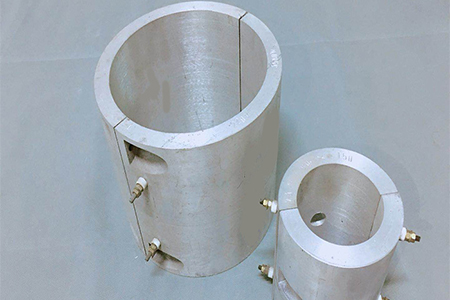
Mica heating coil: High cost-performance, uniform heating, but moderate temperature resistance (about 500°C), afraid of moisture and severe vibration, suitable for normal working conditions.
Ceramic heating coil: High temperature resistance (up to 800-1000°C), good insulation, corrosion resistance, long life, but relatively brittle, suitable for high-temperature, corrosive, or high-cleanliness environments.
Cast aluminum/cast copper heating coil: Fast heat conduction, large heat capacity, stable temperature, not easily deformed, suitable for precision equipment requiring high temperature control accuracy and long-term stable operation.
Electromagnetic induction heating coil: Uses alternating magnetic fields to make the barrel itself heat up, with extremely high thermal efficiency (>90%), significant energy-saving effects, but high cost, requires a dedicated control board, suitable for energy-saving retrofits of high-energy-consumption equipment.
Heating Plate Selection
Stainless steel heating plate: Most widely used, corrosion-resistant, easy to clean, can be made ultra-thin (<1mm), suitable for laboratory, food, and general industrial heating.
Cast aluminum/cast iron heating plate: Large heat capacity, extremely uniform surface temperature, not easily deformed, suitable for industrial scenarios requiring large-area, high-stability heating.
Ceramic/far-infrared heating plate: High radiation rate, low thermal inertia, fast heating and cooling, non-stick surface, suitable for processes requiring rapid temperature changes or non-stick properties.
Teflon anti-corrosion heating plate: Surface treated with non-stick and anti-corrosion coating, specially designed for strong corrosive conditions such as laboratory sample digestion and acid driving.
General Usage and Pitfall Avoidance Guide
Fit is the lifeline: For heating coils, the gap between the inner diameter and the outer diameter of the barrel should be controlled within ±0.5mm. Poor fit can cause heat accumulation and quickly burn out the heating coil.
Strictly prohibit dry burning: Unless it is a specially designed dry-burning type, ensure that the effective heating area of the heating element is fully in contact with the heated object or immersed in the medium.
Surface load must match: Power is not necessarily better. Calculate the power per unit area (W/cm²) based on heat dissipation conditions; excessive power can cause local overheating, shorten lifespan, or even cause accidents.
Regular maintenance: Clean carbon deposits, scale, or material residues on the surface promptly, as these contaminants severely hinder heat dissipation. Check if wiring terminals are loose or oxidized, and ensure reliable grounding of the equipment.
Pay attention to temperature control system: The performance of heating elements relies on precise temperature control. Ensure the thermocouple is positioned correctly and the controller parameters (such as PID) are set reasonably to achieve stable and uniform heating.