
Heating coil heating plate
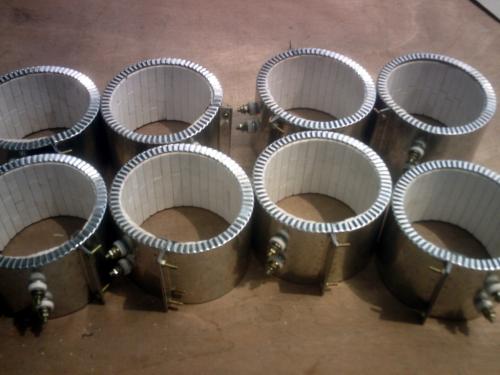
Heating coils and heating plates are the two most commonly used types of electric heating elements in the industrial electric heating field. Essentially, both are devices that convert electrical energy into thermal energy, with the main difference lying in their shape and structure - heating coils are ring/cylindrical shaped, mainly used to wrap around cylindrical objects such as barrels and pipes; heating plates are flat or specially shaped plates, mainly used for flat heating scenarios such as molds and ovens.
Heating Coil
A heating coil (also known as electric heating coil or heating ring) is a ring-shaped electric heater made with electric heating alloy wire as the heating element, wrapped in thin metal sheets or cast metal shells. It is widely used for barrel heating in plastic machinery such as injection molding machines, extruders, blown film machines, and pelletizers.
Classification by Material
Table
Download as Table
Export as Image
Type Maximum Temperature Surface Load Features
Stainless Steel Mica Heating Coil Approximately 300°C Low Simple structure, low cost, suitable for conventional heating
Stainless Steel Ceramic Heating Coil Approximately 450°C 6.5W/cm² Ceramic strip with wire threading structure, fast heat transfer, long lifespan, energy saving about 30%
Cast Aluminum Heating Coil 300~450°C 2.5~4.5W/cm² Die-cast molding, uniform heat conduction, high mechanical strength
Cast Copper Heating Coil 500~600°C 3.5~5.0W/cm² Higher temperature resistance, better thermal conductivity than cast aluminum
Cast Iron Heating Coil 550~700°C 4.5~6.0W/cm² Highest temperature resistance, suitable for high-temperature conditions
Electromagnetic Heating Coil Above 500°C — Induction heating principle, saves 50%~80% electricity, reduces preheating time by 2/3
Quartz Heating Coil Approximately 600°C — Far-infrared radiation heating, high electrothermal conversion efficiency, corrosion resistant
Nano Heating Coil Depends on specific product — New energy-saving product, high thermal efficiency
Heating Plate
A heating plate is a flat heating device made by embedding or casting electric heating elements into metal or non-metal plates. It is widely used in mold heating, laboratory heating, industrial ovens, pipeline heat tracing, and other scenarios.
Classification by Panel Material
Table
Download as Table
Export as Image
Type Maximum Temperature Features Applicable Scenarios
Stainless Steel Heating Plate ≤300°C Corrosion resistant, good mechanical strength, high cost-performance Conventional heating, supporting heavy loads
Cast Aluminum/Cast Copper Heating Plate 300~600°C Uniform heat conduction, long lifespan, customizable shapes Plastic machinery dies, molds
Graphite Heating Plate Above 800°C Fast heat conduction, uniform temperature, resistant to strong acids and alkalis Laboratory acid digestion, high-temperature harsh environments
Ceramic/Microcrystalline Glass Heating Plate 400~600°C Smooth surface, no rust, acid and alkali resistant Laboratory heating, semiconductor samples
Silicone Rubber Heating Plate Lower temperature Ultra-thin and flexible, waterproof and moisture-proof, can conform to irregular surfaces Tight fit heating, moisture-proof environments
Carbon Crystal/Carbon Fiber Heating Plate Low temperature Electrothermal conversion rate >98%, fast heating Low-temperature radiant heating
Classification by Structure Type
Thin-shell type: Spiral electric heating wire embedded in thin metal shell, simple structure and cheap, mostly small power below 800W
Cast plate type: Plate surface is metal casting, high strength and not easily deformed, mainstream structure in China
Tubular element type: Metal tubular element bent into flat spiral involute, large heat transfer area
Tubular element cast plate type: Tubular element cast into alloy plate, maximum mechanical strength and longest lifespan, suitable for vibration environments
Electromagnetic Heating vs. Resistance Heating
In recent years, electromagnetic heating technology has rapidly become popular in the field of heating coils/plates, with obvious advantages compared to traditional resistance heating:
Table
Download as Table
Export as Image
Comparison Item Resistance Heating Electromagnetic Induction Heating
Heating Principle Current passes through resistance wire to generate Joule heat High-frequency alternating magnetic field causes the heated object itself to generate eddy currents for heating
Thermal Efficiency Generally 60%~70% >96%
Electricity Saving Effect Baseline Saves 30%~80% electricity
Preheating Time Longer Reduced by about 2/3
Surface Temperature High shell temperature (above 150°C) Shell close to room temperature, can be touched
Service Life Resistance wire prone to aging Coil itself does not generate heat, lifespan can reach over 10 years
Retrofit Difficulty — Can directly replace original resistance coil without modifying equipment structure
Parameters Required for Ordering/Selection
Whether for heating coils or heating plates, the following information is usually required for customization:
Dimensions: For heating coils, provide inner diameter and width; for heating plates, provide length, width, and thickness
Rated voltage and power
Operating temperature range
Lead wire form, length, and position
Position and size of thermocouple holes or cutouts
Whether insulation layer is needed (adding insulation can save about 20%~35% electricity)
Special requirements: such as explosion-proof rating (ExdⅡBT4, etc.), air-cooled/water-cooled structure, special shapes, etc.
Usage Precautions
Working voltage must not exceed 10% of the rated value
Wiring parts should be placed outside the heating layer and insulation layer, and the shell must be effectively grounded
The effective heating area must be in close contact with the heated object, and dry burning is strictly prohibited
After long-term storage (more than three months), before use, it should be dried by intermittent power-on (heat for 10 minutes, stop for half an hour, repeat 3~4 times) to expel internal moisture
If insulation resistance is below 1MΩ, it can be restored by baking in a 200°C oven for 5~6 hours
Avoid direct contact with corrosive media and moisture, store in a ventilated and dry place