
Heating Coils and Heating Plates
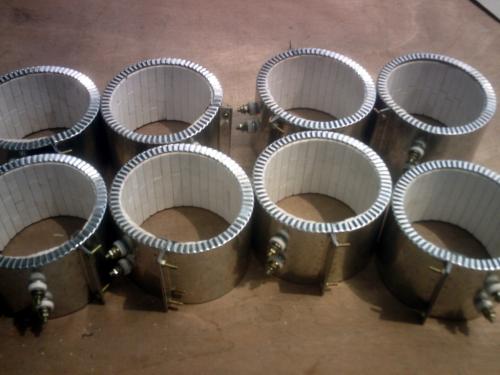
Heating coils (electric heating coils/heating elements) and heating plates (electric heating plates) are two types of electric heating elements with different structural forms but similar principles in the field of industrial heating. Heating coils are ring-shaped and are mainly used to wrap around cylindrical barrels (such as injection molding machine barrels) for outer wall heating; heating plates are flat and are mainly used for flat surface contact heating (such as mold preheating, heat sealing, constant temperature tables). The two are often used together in scenarios such as injection molding, extrusion, packaging, and food machinery.
Both work based on the Joule effect of electric current: current passes through an internal electric heating alloy wire (nickel-chromium alloy or iron-chromium-aluminum alloy) to generate heat, and the heat is conducted through an insulating and thermally conductive medium to the metal shell, and then heats the target object through contact conduction. The difference lies in the heat transfer geometry—heating coils transfer heat radially inward, while heating plates transfer heat in a single plane direction.
Heating Coils
Resistance wire is wound on mica sheets or ceramic cores as the heating body, wrapped with stainless steel plates or aluminum plates rolled into a ring shape, and both ends are fastened to the heated barrel with bolts or clamps. The typical structure is a three-layer concentric structure of "resistance wire → mica insulation layer → metal shell".
Heating Plates
After the electric heating wire is evenly arranged, it is cast into an aluminum alloy matrix (cast aluminum heating plate), or the resistance wire is encapsulated between insulating films to form a flexible heating sheet attached to a metal panel. The cast aluminum type is integrally die-cast, with no splicing seams, and better thermal conductivity uniformity.
Type Features Typical Applications
Stainless steel mica heating coil Low cost, maximum temperature about 400°C, simple structure Injection molding machine barrel, extruder heating section
Stainless steel ceramic heating coil Higher temperature resistance (up to above 700°C), excellent insulation High-temperature working conditions, laboratory equipment
Cast aluminum heating coil Integrally formed, uniform heat conduction, long life, vibration resistance Injection molding machines, film blowing machines, wire drawing machines
Nano infrared energy-saving heating coil Multi-layer composite structure (far-infrared layer + heat insulation layer), energy saving 30%–80% Energy-saving renovation of injection molding machines/extruders
Induction heating coil Heating by eddy current effect, non-contact, extremely fast heating Metal heat treatment, pipeline preheating
Heating Plate Classification
Table
Download as Table
Export as Image
Type Features Typical Applications
Cast aluminum heating plate Aluminum alloy integral die-casting, uniform heat conduction (temperature difference ≤±2°C), temperature resistance 400°C Injection mold preheating, hot runner auxiliary heating
Mica sheet heating plate High temperature resistance (up to 800°C), excellent insulation, small size Laboratory equipment, low-power constant temperature modules
Silicone heating plate Flexible and bendable, uniform surface source, good fit Curved tank insulation, pipeline heat tracing
Ceramic heating plate Alumina substrate + thick-film printed resistor, breakdown voltage ≥2.5kV Medical beauty instruments, constant temperature incubators
Far-infrared heating plate High radiation efficiency, emission wavelength matches the resonance frequency of water molecules Drying and curing, drying of Chinese medicinal materials
Parameter Heating Coil Heating Plate
Diameter/Size φ30mm–φ800mm (customizable) 50mm×50mm–1000mm×2000mm (customizable)
Thickness 10mm–50mm 6mm–80mm
Voltage 24V / 110V / 220V / 380V 24V / 110V / 220V / 380V
Power Range 100W–30kW 200W–50kW
Surface Power Density 2.5–4.5W/cm² (cast aluminum type) 2.5–4.0W/cm² (cast aluminum type)
Maximum Operating Temperature Mica type ≤400°C, ceramic type ≤800°C Cast aluminum type ≤400°C, ceramic type ≤800°C
Temperature Uniformity ±2°C–±5°C ±2°C–±5°C
Insulation Resistance ≥50MΩ (cold state) ≥50MΩ (cold state)
Service Life Ordinary type 1–2 years, cast aluminum type 2–3 times Ordinary type 1–2 years, cast aluminum type 2–3 times
📐 Power Calculation Method
The power calculation of cast aluminum heating coils/heating plates follows the following engineering formulas:
Surface Load Method (quick estimation):
Heating coil power = diameter (cm) × 3.14 × height (cm) × surface power density (2.5–4.0W/cm²)
Heating plate power = length (cm) × width (cm) × surface power density (2.5–4.0W/cm²)
Heating Power Method (precise calculation):
P = (m × c × ΔT) / (t × η)
Where: m is the mass of the heated body (kg), c is the specific heat capacity [J/(kg·°C)], ΔT is the temperature rise difference (°C), t is the heating time (s), and η is the thermal efficiency (generally 0.6–0.8). In engineering, it is usually multiplied by a safety factor of 1.2–1.5 to compensate for heat loss.
Plastic Machinery: Injection molding machine barrel heating (heating coil) + mold preheating (heating plate), which is the most core application scenario
Extrusion and Film Blowing: Heating of each section of the extruder, heating of the die head of the film blowing machine
Packaging Machinery: Heat sealing knives, heat shrink tunnels, sealing heating plates
Food Processing: Constant temperature tables, fryer heating, baking equipment
Rubber Products: Vulcanizing machine heating plates, rubber calender roll heating
Laboratory and Medical: Constant temperature incubators, sterilizers, constant temperature water baths
New Energy: Lithium battery pole piece baking, auxiliary heating for battery production
Comparison of Heating Coils and Heating Plates
Table
Download as Table
Export as Image
Comparison Item Heating Coil Heating Plate
Geometric Form Ring-shaped/cylindrical Flat/curved
Heat Transfer Direction Radially inward Plane unidirectional
Installation Method Sleeved on the outer wall of the barrel, fixed with bolts/clamps Attached to a flat surface, installed with bolts or embedded
Core Scenario Cylindrical barrel heating (barrel, pipeline) Flat surface heating (mold, heat sealing, constant temperature table)
Customization Focus Inner diameter, width, opening method Length and width dimensions, mounting hole positions, flatness
Uniform Heat Conduction: Cast aluminum type is integrally formed, temperature deviation can be controlled within ±2°C
Fast Heating: Aluminum material has high thermal conductivity, and heating efficiency is increased by about 30% compared with ordinary heating plates
Long Life: The cast aluminum heating body fits tightly with the aluminum substrate, resistant to oxidation and deformation, and its life is 2–3 times that of the ordinary type
Safe and Reliable: Built-in high-temperature insulation material, insulation resistance ≥50MΩ, eliminating hidden dangers of leakage
Flexible Customization: Dimensions, power, and mounting hole positions can be customized on demand, supporting various shapes such as flat and curved
🛒 Selection Points
Clarify the Heating Object: Choose heating coils for cylindrical barrels, heating plates for flat molds, and silicone flexible heating plates for curved tanks
Determine the Working Temperature: Choose cast aluminum type for ≤400°C, ceramic type for 400°C–800°C, and mica or special alloys for higher temperatures
Power Matching: Calculate the required power according to the surface load standard (2.5–4.0W/cm²) and heating time requirements
Temperature Uniformity Requirements: Scenarios such as precision injection molding require cast aluminum integral forming, with temperature difference ≤±2°C
Energy-Saving Needs: Consider nano infrared energy-saving heating coils, with a general investment payback period of 6–12 months
Installation Space: Confirm the installation hole diameter, fastening method, and wiring position. Non-standard sizes require advance communication with the manufacturer for customization