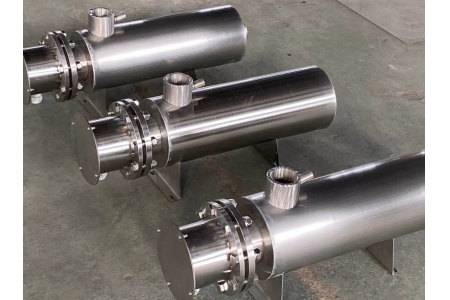

Tubular Electric Heater
Tubular electric heater (Tubular Heater / Sheathed Heating Element) is the most common and widely used resistive electric heating device, widely applied in heating liquids, air, metal molds, etc., covering household appliances, industrial equipment, commercial equipment, and laboratory equipment.
Working Principle
The core principle of a tubular electric heater is the Joule heating effect: when current passes through the resistance heating wire inside the tube, heat is generated, transferred through the magnesium oxide insulating and thermally conductive layer to the metal sheath surface, and then from the tube surface to the external medium (liquid, air, or solid).
The basic formula for electrothermal conversion is:
Q = 0.2388 · I²Rt
Where Q is heat (calories), I is current (A), R is resistance (Ω), and t is time (s).
Structural Composition
A tubular electric heater consists mainly of the following parts from inside to outside:
Resistance heating wire: the heating core, usually made of nickel-chromium wire (Ni-Cr) or iron-chromium-aluminum alloy wire (Fe-Cr-Al)
Magnesium oxide powder (MgO): filled between the heating wire and the sheath, providing good thermal conductivity and electrical insulation, available in different specifications such as high-temperature and medium-temperature grades depending on operating temperature
Metal sheath: protective shell, commonly made of stainless steel (304, 316L, 310S), In800, In840 heat-resistant alloys, aluminum, copper, low-carbon steel, etc.
Sealing material: seals the tube ends to prevent moisture absorption of magnesium oxide powder, commonly using epoxy, silicone, glass, etc.
Lead rods/terminals: for external power connection, usually made of stainless steel or free-cutting iron
Shape Classification
Table
Download as table
Export as image
Type Features
Straight single-end heating tube Lead wire at one end only, suitable for plug-in installation
Straight double-end heating tube Lead wires at both ends, simple structure
U-shaped heating tube Bent into U shape, increases heating density per unit area
W-shaped heating tube Multiple bends, suitable for large-area uniform heating
Spiral heating tube Spiral winding, suitable for heating inside pipes
Custom-shaped heating tube Customized shapes according to user equipment
Main Features
High thermal efficiency: almost all electrical energy is converted to heat and transferred to the heating medium
Simple structure and low cost: mature manufacturing process, economical price
Good mechanical strength: durable metal sheath, can withstand certain pressure
Strong adaptability: can be used to heat air, water, oil, chemical media, low-melting-point metals, etc.
Long service life: high reliability when surface load is properly designed
Easy installation: size and shape can be customized according to equipment requirements
Typical Technical Parameters
Table
Download as table
Export as image
Parameter Specification
Tube diameter range Φ3mm~Φ30mm
Rated voltage 220V / 380V
Operating temperature Depends on material, up to 850℃
Insulation resistance ≥1MΩ
Dielectric strength 2KV/1min
Surface load 1~11W/cm² (depending on medium)
Explosion-proof rating Up to Exd ⅡB/ⅡC T4/T6 (explosion-proof models)
Pressure resistance Up to 20MPa (special models)
Armored Type (Special Type)
Armored cable-type electric heating elements are upgraded products developed based on conventional tubular heating elements, drawing on the manufacturing process of armored thermocouples. Through repeated drawing, reduction, and annealing, they form a compact solid structure with the following outstanding advantages:
Slender shape: diameter φ1~6mm, length up to 2~60 meters
Good flexibility: can be bent arbitrarily like a cable, meeting complex heating environment requirements
High insulation strength: insulation resistance at room temperature up to 1000MΩ, about 20 times higher than conventional tubular elements
Uniform heating: resistance wire is linearly distributed, ensuring uniform heat transfer, basically eliminating factors causing uneven heating
Good mechanical strength: can withstand external pressure up to 64MPa
Application Fields
Household appliances: water heaters, ovens, coffee makers, electric kettles, etc.
Industrial equipment: heating air, oil, water, chemical media, hot press molds
Petrochemical industry: heating crude oil, heavy oil, heat transfer oil, and other media
Special heating: melting salts, alkalis, and low-melting-point alloys
Aerospace, rubber and plastics, food processing, medical equipment, and other industries
Usage Precautions
Strictly avoid dry burning: the effective heating zone must be fully immersed in liquid or solid metal, otherwise the tube will overheat and burn out quickly
Regular cleaning: remove scale or carbon deposits on the tube surface promptly to prevent affecting heat dissipation and shortening service life
When heating fusible solids (such as nitrate salts, paraffin, asphalt, etc.), first reduce the voltage, and after the medium melts, raise it to the rated voltage
When heating air: elements should be arranged crosswise and evenly to ensure good heat dissipation conditions
The wiring part should be placed outside the insulation layer to avoid contact with corrosive, explosive media, and moisture
Storage requirements: store in a dry place; if insulation resistance drops below 1MΩ due to long-term storage, dry in an oven at 200℃ or apply reduced voltage to restore it
Working voltage should not exceed 1.1 times the rated value, and the shell should be effectively grounded
Related Standards
JB/T 2379: Metallic tubular heating elements
JB/T 4088: Daily-use tubular heating elements
GB/T 23150: Tubular heaters for water heaters (under revision)
GB 4706.1: General safety requirements for household and similar electrical appliances
JB/T 13620.9: Tubular heaters for hot runner systems of plastic injection molds