
Heating Coils and Heating Plates
Heating coils (electric heating coils/heating rings) and heating plates (electric heating plates/heating panels) are the two most common types of heating elements in the field of industrial electric heating. The former has a ring structure and is mainly used for wrap-around heating, while the latter has a flat structure and is mainly used for contact heating. Both share the same core principle—using electric heating alloy wires (such as nickel-chromium alloy wires) to convert electrical energy into heat energy. The difference lies in their structural form and applicable scenarios.
Main Types
Heating coils and heating plates can be divided into the following major categories according to the heating element structure and shell material:
Stainless steel mica type 150–450°C Long service life, good heat preservation, corrosion resistance, magnetic field resistance, surface load 2.5–3W/cm² Injection molding machines, extruders, mold heating
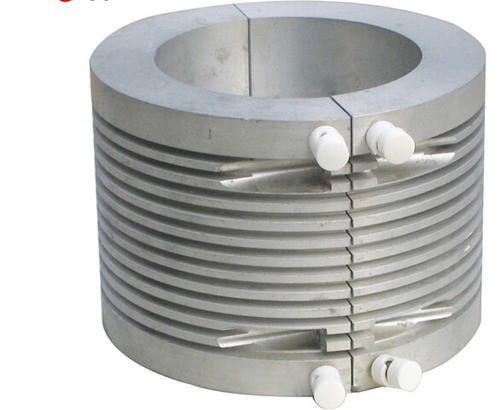
Cast aluminum type Maximum about 400°C Fast heat conduction, uniform temperature (±3°C), high mechanical strength, surface load 2.5–4.5W/cm² Injection molding machine die heads, hot-pressing templates, pelletizers
Cast copper/cast copper type Maximum about 500°C Better thermal conductivity than cast aluminum, suitable for higher temperature working conditions Chemical equipment, rubber machinery
Ceramic type Maximum up to 800°C High temperature resistance, excellent insulation, suitable for low-power constant-temperature scenarios Laboratory equipment, constant-temperature modules
Silicone rubber type Maximum 250°C Good flexibility, can fit curved surfaces, thickness about 1.5mm, power up to 1.2W/cm² Pipeline heat tracing, oil drum insulation, medical equipment
Electromagnetic induction type Can reach above 500°C Heat conversion efficiency >96%, saves 50%–80% electricity compared with resistance type, equipment surface can be touched Pelletizers, film blowing machines, energy-saving renovation of pipeline heating
Working Principle
Resistance type (mainstream)
Electric heating alloy wire (nickel-chromium wire) is wound on a mica skeleton or ceramic core as the heating element, and the outside is covered with a metal shell such as stainless steel or cast aluminum. After power is supplied, current passes through the resistance wire to generate Joule heat, and the heat is conducted through the shell to the object being heated.
Electromagnetic induction type (energy-saving type)
The control board rectifies and inverts the power-frequency AC into 18–30kHz high-frequency AC, generating an alternating magnetic field through the induction coil, causing the metal barrel itself to generate eddy currents and heat. Heat is generated from inside the barrel, and the thermal efficiency is far higher than that of traditional resistance-type external heating.
Power Calculation Method
The power design of heating coils/heating plates needs to comprehensively consider surface load, heating requirements, and heat dissipation compensation:
Surface load method (quick estimation)
The surface load of cast aluminum heating coils/plates is generally taken as 2.5–4.0W/cm²
Heating coil power ≈ diameter (cm) × 3.14 × height (cm) × surface load (W/cm²)
Heating power calculation
P = (m × c × ΔT) / (t × η)
P: heating power (W)
m: mass of the object being heated (kg)
c: specific heat capacity (900 J/(kg·°C) for aluminum)
ΔT: temperature rise difference (°C)
t: heating time (s)
η: thermal efficiency (generally taken as 0.6–0.8)
Total power selection
P total = (heating power + heat dissipation power) × safety factor (1.2–1.5)
Example: For a 250mm×400mm×500mm aluminum plate mold, heating from 20°C to 180°C, taking 1 hour, with a margin factor of 1.25, the required power is about 6.76kW.
Differences Between Heating Coils and Heating Plates
Comparison item Heating coil Heating plate
Structural form Ring-shaped/cylindrical Flat/irregular
Installation method Sleeved over/wrapped outside the object being heated Attached to the surface of the object being heated
Applicable objects Pipelines, barrels, screw barrels Hot-pressing templates, mold planes, tank bottoms
Typical equipment Injection molding machine barrels, extruder barrels Hot presses, vulcanizing machines, die head flanges
Precautions for Use
The working voltage must not exceed 10% of the rated value
The wiring part should be placed outside the heating layer and insulation layer, and the shell should be reliably grounded
Mica-type heaters should be stored in a dry place; if the insulation resistance is lower than 1MΩ due to long-term storage, it can be restored by baking in an oven at about 200°C for 5–6 hours
For the electromagnetic induction type, the coil spacing should be ≥60mm, and the spacing between the coil and the heating element should be about 15–18mm (including insulation cotton)
Before installation, confirm parameters such as the size of the object being heated, working temperature, required power, and voltage
Main Application Fields
Plastic machinery: heating of barrels and die heads of injection molding machines, extruders, film blowing machines, and pelletizers
Rubber machinery: heating of vulcanizing machines and calenders
Chemical equipment: reactors, pipeline heat tracing, heat transfer oil heating
Cable machinery: heating of cable extrusion production lines
Food machinery: sealing machines, hot-press forming equipment
Medical equipment: blood analyzers, test tube heaters
Energy-saving renovation: replacing traditional resistance heating coils with electromagnetic induction heating coils, with electricity savings of 30%–80%
Key Points for Selection
Clarify the material and size of the object being heated: determines the shape and inner diameter/area of the heating coil/plate
Determine the working temperature range: determines whether to choose mica type (≤450°C), cast aluminum type (≤400°C), or ceramic type (≤800°C)
Calculate the required power: calculate according to the above formula based on heating speed and heat dissipation conditions
Consider installation space: whether there is enough space to install the insulation layer and wiring terminals
Energy-saving needs: for scenarios sensitive to electricity costs, give priority to electromagnetic induction heating solutions. Although the initial investment is higher, the cost can be recovered in 6–12 months