

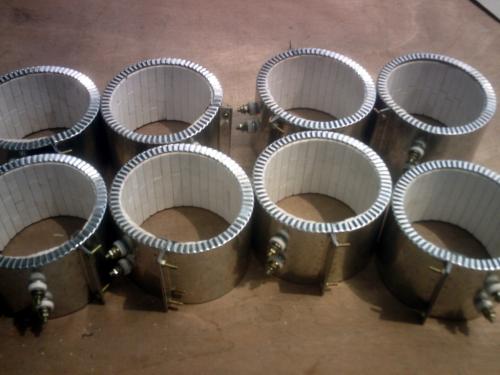
Heating Coil and Heating Plate
Heating coils and heating plates are the most widely used surface heating elements in the field of industrial heating. They are mainly used for temperature control of barrels and molds in injection molding machines, extruders, pelletizers, and other plastic machinery, as well as for heating various industrial ovens and reactors. Based on your daily attention to the selection and procurement of industrial electric heating equipment, the following summarizes their core classifications, selection pitfall avoidance guide, and procurement suggestions for surrounding manufacturers.
Core Structure and Working Principle
The core principle of both heating coils and heating plates is to generate heat through internally embedded resistance wires (such as nickel-chromium alloy), conduct the heat to the external metal or non-metal substrate, and then transfer it to the object being heated. The two differ slightly in structure:
Heating coil: It has a ring-shaped structure, like a "heating version of a donut," and is mainly used to wrap cylindrical barrels, pipes, or nozzles.
Heating plate: It is flat or specially shaped and is mainly used to fit flat molds, heat plates of pressing machines, or as a heating component of ovens.
Key Parameter Guide for Selection
During industrial procurement and selection, it is recommended to focus on confirming the following four dimensions of parameters to match actual working conditions:
Clarify Heating Material and Temperature (Determines Substrate Selection)
Cast aluminum/cast copper heating coil/plate: The electric heating tube is cast into aluminum or copper alloy, providing extremely fast heat conduction, good temperature uniformity, and high mechanical strength. Cast aluminum is suitable for medium and low temperature applications of ≤350°C; cast copper has a higher thermal conductivity and is suitable for precision injection molding at ≤650°C with extremely high requirements for heating speed.
Ceramic heating coil/plate: It uses ceramic fiber as the insulation layer, withstands high temperatures (up to above 600°C), has good insulation performance, and significant energy-saving effects, but is relatively brittle and vulnerable to impact. It is suitable for most injection molding scenarios and high-temperature processes and is currently the most mainstream type in application.
Mica heating coil/plate: The heating wire is wound on a mica support and wrapped externally with stainless steel sheet. It has low cost and light weight, but relatively short service life and is prone to burning out. It is mostly seen in old equipment or occasions extremely sensitive to cost and is gradually being replaced by ceramic heating coils.
Cast iron heating coil/plate: It uses a tubular electric heating element as the heating body, cast into a high-quality metal alloy shell. The surface load can reach 4.5-6W/cm², the maximum working temperature is 550-700°C, the heat distribution is uniform, hot spots and cold spots are eliminated, and it has a long service life and corrosion resistance.
Spring-type heating coil: It is made of high-quality stainless steel into a spring coil structure, available in circular, square, and flat cross-section forms, and can be equipped with K-type, J-type, or E-type temperature control thermocouples. It is widely used in hot runner plastic molds, blow molding machines, extruders, and hot nozzles, and can automatically compensate for thermal expansion and contraction.
Working Condition Temperature and Power Density (Determines Heating Efficiency and Life)
Surface load standards: The surface power borne by cast aluminum heating coils/plates is generally 2.5–4.0W/cm²; the surface load of cast iron heaters can reach 4.5-6W/cm²; the maximum power density of spring-type heating coils can reach 9W/cm².
Power calculation: It needs to be comprehensively considered in combination with the mass of the object being heated, specific heat capacity, target temperature rise, and heating time. Engineering quick calculation formula: aluminum mold heating power ≈ (mass × 900 × temperature difference) ÷ time × 1.3 (safety + heat dissipation coefficient).
Pitfall avoidance tip: Looking only at power without considering matching is a common misunderstanding. A 3000W heating coil installed on a small-diameter barrel will feel hot on the surface, but the heat cannot dissipate, and instead it burns itself out. The key is to see whether the power per unit area matches the heat dissipation capacity of the equipment.
Size Matching and Installation Method (Determines Heat Transfer Efficiency)
Dimensional tolerance: The inner diameter of the heating coil must fit tightly with the outer diameter of the barrel. Excessive clearance will lead to low heat transfer efficiency and increased energy consumption. For a nominal Φ120×50mm heating coil, an actual outer diameter deviation of ±1.5mm may prevent it from fitting closely to the barrel, reducing heat transfer efficiency by more than 30%.
Installation specifications: Before installation, remove old material, oil stains, and rust from the contact surfaces of the barrel and heating coil; tighten the fixing screws evenly in diagonal order to ensure full contact; it is recommended to add an external insulation cover to reduce heat loss, which can improve thermal efficiency by about 20%.
Voltage and Wiring Method
Industrial scenarios commonly use single-phase 220V or three-phase 380V, while some imported equipment uses 110V or 240V.
Wiring methods are divided into single-end lead and double-end lead, which need to be selected according to the on-site electrical layout. The power line connection must be firm, use appropriate wire terminals, and pay attention to phase sequence distribution.
Common Models and Reference to Surrounding Manufacturers
Common heating coil/plate models on the market include cast aluminum/cast copper heating coils, ceramic heating coils, mica heating coils, spring heating coils, cast iron heating coils/plates, etc. Different models correspond to different dimensions, voltages, and power specifications.
In terms of procurement channels, Jiangsu and surrounding areas have concentrated a large number of electric heating equipment manufacturers. In addition to relevant electrical enterprises in Yangzhou (such as Yangzhou Xinrui Electric Heating, Yangzhou Xingshuo Electric Heating, Yangzhou Zhengwu Electric, Yangzhou Haiyue Electric, Yangzhou Hefeng Electric Heating, Yangzhou Haichuang Electric Appliance, Yangzhou Hualian Electrical, Yangzhou Zhongbangling Electric Appliance Factory, etc.), surrounding areas such as Yancheng (such as Yancheng Qingbang Electric Appliance, Yancheng Taiya Electric Heating, Yancheng Hongxingyuan Electric Heating, etc.), Wuxi, and Suzhou also have many source manufacturers with non-standard customization capabilities. It is recommended that during actual procurement, directly provide the manufacturer with the specific medium type, target temperature, installation dimensions, and flange standards, and require them to issue detailed selection drawings and power calculation sheets to ensure long-term stable operation of the equipment.